
Benchmark BSE Sensex tumbled 566 points to settle below the 60,000-level on Wednesday, dragged down by heavy selling in banking and IT stocks amid weak global trends.

Experts believe that waiving off farmers' loans is not the right solution to their problems. If the government puts this money in developing protected agricultural practices, drip irrigation facilities, creating aggregators for the farmers to play in the Futures market and teach them the modern farming methods, they will manage the rest. Farmers usually don't get loans from banks and have to go to moneylenders. They mortgage not just their land, but also homes and equipments.

Equity benchmark Sensex tumbled over 575 points on Thursday, tracking heavy losses in index-heavyweights HDFC twins, TCS and Reliance Industries amid a weak trend in global markets. Declining for the third straight day, the 30-share Sensex slumped 575.46 points or 0.97 per cent to settle at 59,034.95. During the day, it tanked 633.06 points or 1.06 per cent to 58,977.35. The broader Nifty-50 also declined 168.10 points or 0.94 per cent to close at 17,639.55.

Equity benchmarks Sensex and Nifty on Thursday gave up all early gains to settle lower as surging oil prices amid the ongoing conflict between Russia and Ukraine hit investor sentiment. The 30-share BSE Sensex started the trade on a higher note and jumped 527.72 points in morning deals to a high of 55,996.62. However, during the afternoon trade it surrendered all its early gains and finished at 55,102.68, lower by 366.22 points or 0.66 per cent.
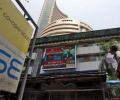
Equity benchmark indices Sensex and Nifty buckled under selling pressure after a nine-session rally on Monday, as massive sell-off in IT, tech and telecom counters unnerved investors.

Benchmark equity indices Sensex and Nifty rallied for a third day in a row on Wednesday on buying in Reliance Industries, Infosys, HDFC twins and ICICI Bank following gains in global equities amid hopes of a breakthrough in Russia-Ukraine peace talks. The 30-share BSE barometer index surged 740.34 points or 1.28 per cent to settle at 58,683.99. During the day, it jumped 784.13 points or 1.35 per cent to 58,727.78. Similarly, the broader NSE Nifty climbed 172.95 points or 1 per cent to settle at 17,498.25. Among the 30-share pack, Bajaj Finserv, Mahindra & Mahindra, Bajaj Finance, Power Grid, HDFC, ICICI Bank, Nestle, Maruti, Reliance Industries Limited were among the lead gainers. On the other hand, ITC, Tata Steel, Tech Mahindra, Bharti Airtel and Titan were among the laggards.
Among the Sensex firms, Kotak Mahindra Bank, Tata Steel, ITC, ICICI Bank, Bajaj Finserv, Maruti, Mahindra & Mahindra and State Bank of India were the biggest winners. Tata Consultancy Services, Infosys, HCL Technologies, Tech Mahindra, Asian Paints, Wipro and Tata Motors were the biggest laggards.

After clocking losses for seven straight quarters, Tata Motors on Wednesday posted a consolidated net profit of Rs 3,043 crore in the third quarter (Q3) of 2022-23. This came on the back of a strong order book, better semiconductor chip supply, tempered commodity prices, and a better product mix. "We remain cautiously optimistic about the demand situation, notwithstanding the global uncertainty.

Less-than-expected rainfall and a poor spatial distribution, experts say, can rekindle fears of a rise in food and fuel inflation that can have an impact on the RBI's monetary policy. The fear of less than optimal rainfall due to El Nino this year, analysts believe, is the biggest short-term risk for the markets, which they said has not been fully priced in yet by them. Monsoon set over Kerala on June 08, a week later than its scheduled date.

India's largest two-wheeler maker by volume - Hero MotoCorp (Hero) - posted a better-than-expected operating performance in the January-March (fourth quarter, or Q4) quarter of 2022-23 (FY23). Riding on higher average selling prices which were up 5 per cent year-on-year (YoY) and volume growth of 7 per cent, the company registered a 12 per cent growth in revenue to Rs 8,306 crore. The company sold 127,000 units in the quarter, largely driven by domestic sales which were up 11.6 per cent, while exports saw a sharp fall of 57 per cent over the year-ago quarter.
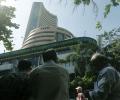
BSE benchmark Sensex plummeted over 388 points to close at 58,576.37 on Tuesday, tracking weakness in index majors Wipro, RIL and Bharti Airtel amid a weak trend in global markets. Investors also remained cautious ahead of crucial macroeconomic data announcements -- industrial production for February and inflation rate for March -- post trading hours. The Sensex declined 388.20 points or 0.66 per cent to settle at 58,576.37. During the day, the benchmark tanked 666 points or 1.12 per cent to 58,298.57.

The recent currency volatility - rupee's depreciation against international currencies - may have given heartburns to automakers that rely on imports or pay royalty to parent companies abroad. But for Maruti Suzuki India, favourable movement of the yen - the currency that matters the most - against the Indian rupee, has given it reasons to cheer. The yen's sharp fall against the rupee and the rupee's depreciation against the US dollar, which in turn will bump up export realisations, are set to give a margin boost to the maker of Baleno and Brezza, said analysts. The softening of commodity prices and slew of new SUV launches in the coming months will also aid margins, they said.

After lagging behind other segments in the automotive (auto) space over the past few years, two-wheelers are expected to reverse their volume underperformance. After witnessing a 36.3 per cent volume decline over the 2018-19 (FY19) through 2021-22 (FY22) periods, the sector staged a recovery in 2022-23 (FY23), with volumes rising 17 per cent. While volumes are still a quarter lower than the FY19 peak of 21 million units, a double-digit growth trajectory is expected to prolong.

From the 30-share pack, Sun Pharma, TCS, Tech Mahindra, NTPC, Wipro, UltraTech Cement, Dr Reddy's Laboratories and Infosys were the major gainers, jumping up to 3.99 per cent. In contrast, Tata Steel, Nestle, Titan Company, PowerGrid, Reliance Industries Limited and State Bank of India were among the laggards.

Bajaj Auto has amended its dividend distribution policy as it seeks to reward its shareholders and boost return ratios. The amended policy will also consider the surplus the company has when calculating the dividend payout as a percentage of profits after tax, the Pune-based firm said in a stock exchange filing on Thursday.

After a stellar run that saw the frontline indices - the S&P BSE Sensex and the Nifty 50 - clock gains of around 21 per cent and 24 per cent respectively in calendar year 2021 (CY21), the year gone by in real sense belonged to the mid-and small-cap segments. Thus far in CY21, the mid-and small-cap indexes on the BSE have far outpaced the run in the frontline indices and notched up a gain of around 38 per cent and 61 per cent, respectively during this period. Though analysts expect the outperformance to continue in 2022, they caution against the multiple headwinds in the year ahead that may dent the overall market sentiment.
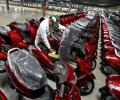
What has hit sentiment further is a draft proposal by the government to increase vehicle insurance premiums for financial year 2022-23 (FY23). Third-party motor insurance premiums have not been increased over the last two years and if this is approved, insurance costs for specific segments could rise by a fifth. The worst impacted is the 350cc and above two-wheeler segment, where premiums are up 21 per cent. Royal Enfield (Eicher Motor) is the market leader in the segment. The premiums in the 150-350cc two-wheeler category are also being inc
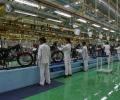
Riding on an improved show across parameters, TVS Motor (TVS) outperformed larger two-wheeler peers Hero MotoCorp (Hero) and Bajaj Auto (Bajaj) during the September (Q2 of FY23) quarter. The Chennai-based firm, which has the most-diversified portfolio among two-wheeler majors, posted a 28 per cent jump in revenues. This compares to 18 per cent growth for Bajaj Auto and single-digit uptick for Hero MotoCorp.

The economy segment of India's car market is unlikely to revive soon term as inflation and prices prompt buyers to defer purchases. The share of entry-level cars in the passenger vehicle market dropped to the lowest in seven years at the end of the Financial Year 2021-22 (FY22). A recovery in the segment will be largely driven by the overall economic growth, improvement in income levels, and easing of semiconductor shortage, say carmakers and analysts.
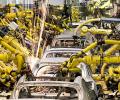
The sharp increase in commodity prices on account of the Russia-Ukraine war has put automakers in a fix. After the frequent price hikes in the current fiscal, manufacturers fear that any more price increases may further dent the already weak demand in certain segments. "We have taken several hikes and cannot immediately do it again. "We will have to closely watch the situation and act accordingly," said an official at an auto firm, declining to be identified. Even for companies like Tata Motors Passenger Vehicles, which has had a strong volume run and a robust order book, passing on the entire costs has been tough.
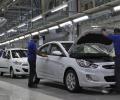
The optimism stems from benign fuel prices, adequate and well distributed rainfall and the recent measures announced by the government to boost liquidity at banks and NBFCs.

To be able to tide over the current crisis, automobile manufacturers have waged a war against all cost heads.

The lockdown in Maharashtra will have a catastrophic impact on April sales, as dealers will not be able to realise the potential of festivities like Ugadi, Gudi Padwa, Baisakhi and Poila Boishakh.

In September, sales of 125cc models - that include the Hero Glamour, Splendor, Pulsar 125, Victor Star City, among others - grew by a whopping 30 per cent over the same period a year ago to 305,615 units.

Cumulative sale at India's top six passenger vehicle (PV) makers dropped 0.7 per cent to 267,000 units, from 269,000 a year before.

Maruti is sticking to this strategy at a time when rival Hyundai is looking to make the most of the monopoly it will have in the compact diesel segment from April 1, 2020, when the BSVI emission norms kick in. The market leader's confidence stems from the rapid shift in favour of petrol in the PV segment. For newer models such as MG Hector and Seltos, nearly 75 per cent bookings are for petrol variants, Kia has 55 per cent from petrol variants. The change in customer preference from diesel variants to petrol has happened quickly over the past few years.
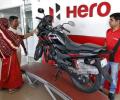
Besides regular buyers, there is lot of interest among those in essential services, such as health, banking, and IT. The sales will be helped by social distancing becoming the new normal in both urban and rural regions as people will be averse to using public transport.

US auto major Ford Motor Co on Friday said it and India's Mahindra & Mahindra have decided to scrap their previously announced automotive joint venture and it will continue its independent operations in India as it is. The two companies determined that they will not complete a previously announced automotive joint venture between their respective companies. The decision follows the passing of the December 31, 2020 'longstop' or expiration date of a definitive agreement the organisations entered into in October 2019, Ford Motor Company said in a statement.

After the easing of lockdown in mid-May, auto companies were able to resume production in a phased manner, but the ramp-up was slow due to a broken supply chain, and lockdown-induced restrictions.

The business will also see a change of guard. Shailesh Chandra, president of EV and corporate strategy, will replace Mayank Pareek as president of PV business, including EV, with effect from April 1. Pareek will be superannuating from the company after a six-year stint at the end of February 2021. Chandra and Pareek will work on transition over the next few weeks.

The growth in the PV segment was primarily led by car market leader, Maruti Suzuki India, which saw its dispatches to dealers grow 4.4 per cent YoY to 144,277 units after 10 months of drop. It was driven by new launches, such as the S-Presso, a mini sport UV.

The first half of 2019-20 will be under pressure, since prices are expected to go up by Rs 7,000-8,000 at a time when sentiment is poor.

Tata Motors has halved the volume outlook for its UK subsidiary Jaguar Land Rover Automotive (JLR) and warned of lower earnings as it sees the semiconductor shortage deepening in the September quarter of the current financial year, according to a notification issued by the company to the stock exchanges on Tuesday. The announcement caught investors unawares. They were hoping for a quicker recovery. Tata Motors' stock tanked 13 per cent (on July 6) from the day's high of Rs 358.10 and hit the lower circuit (Rs 311.45) in intra-day trades.

Analysts say Bajaj's move to correct prices can potentially disrupt the market.

Rediff.com's Love Guru has answers to all your relationship problems.

The transaction - the second one in less than a year - is seen as an effort to restore investor faith in the company following a dismal performance by its UK subsidiary, Jaguar Land Rover Automotive.
In a circular dated May 20, Sebi had directed the listed companies to evaluate the impact of Covid-19 on their capital and financial resources, profitability, liquidity position, assets, and ability to service debt. Instead, companies have spoken about the number of plants, warehouses and distribution centres that have resumed operations; work-from-home and safety measures undertaken for employees; and the labour shortage they are facing.

Now, you can own a two-wheeler for Rs 18.5 per day
 © 2026 Rediff.com - Advertise with us - Disclaimer - Privacy Policy - Sitemap - Feedback - About us - Terms of use - Grievances